If you’ve ever shopped for water feature stones, you’ve probably paused mid-scroll over a listing, squinted at the product photos, and thought: Wait, how heavy is that really? Because let’s be real—you can’t exactly judge a boulder’s weight from a 2-inch photo, and hauling a 50-pound stone up a backyard slope is the kind of surprise that turns a backyard oasis project into a one-man workout that leaves you icing your back for a week. As a water feature stones supplier, this is one of the most common questions I get, and it’s not a trivial one. It’s the difference between designing a feature that fits your space, fits your budget, and fits your sanity. Water Feature Stones
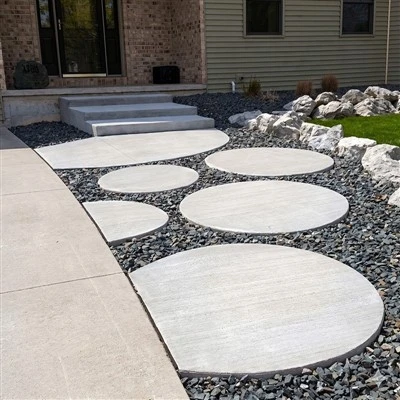
Let’s start with the basics. Water feature stones aren’t a one-size-fits-all commodity. They come in all shapes, sizes, and materials, and each of those variables changes their weight more than you’d think. The mistake a lot of DIYers make is assuming all decorative stones weigh roughly the same as, say, a bag of patio gravel. But those tiny pea gravel stones? You can carry a 50-pound bag one-handed. A 12-inch smooth river rock that’s meant to be the centerpiece of a small fountain? That’s not even close. To get this right, you have to start with two key factors: the type of stone and its volume. That’s where the science comes in, and it’s simpler than it sounds.
First, stone density. Density is the amount of mass in a given volume, and it’s the biggest driver of weight. Not all rocks are equal in density, and that’s why a piece of slate can feel lighter than a similar-sized piece of granite. Let’s break down the most common types we work with, since those are the ones our customers ask about most.
Granite is the heavyweight champ here. It’s an igneous rock, formed from cooled magma deep underground, and its density averages about 2.7 grams per cubic centimeter (g/cm³). For reference, water is 1 g/cm³, so granite is nearly three times heavier than water. A 1-cubic-foot chunk of granite weighs roughly 168 pounds. That’s a big deal. If you’re planning a large, multi-tiered water feature, the base stones are almost always granite because they’re durable, they hold up to freeze-thaw cycles, and their weight prevents the whole structure from shifting. But you can’t just plop a 168-pound boulder on a wooden deck, right? That’s why we always share weight specs for every product on our site—not just dimensions.
Next, river rock. These are the smooth, rounded stones you see lining small fountain basins or tucked into the edges of patio ponds, worn down by centuries of river current. Their density is a little lower than granite, averaging around 2.65 g/cm³, and that’s because they’re often slightly porous, especially if they’ve been exposed to water for a long time. Wait, porous? You might think “porous stone” would be bad for water features, and it can be if you pick the wrong type, but river rock is dense enough to not absorb too much water, which means its dry weight is pretty consistent. A 1-cubic-foot river rock weighs around 165 pounds, almost the same as granite, but because they’re rounded, they feel a little easier to lift (though don’t let that fool you—you can still pull a muscle trying to carry a 1-cubic-foot river rock by yourself).
Then there’s fieldstone, slate, and limestone. Fieldstone is the irregular, chunky rock you dig up from pastures, and its density varies a lot depending on where it’s from. Most fieldstone we source for water features averages around 2.5 g/cm³, so a cubic foot is about 156 pounds. Slate is a metamorphic rock, very flat and layered, with a density of about 2.75 g/cm³—slightly heavier than granite, but because it’s thin, a 12-inch square slate flagstone that’s 1 inch thick only weighs about 17 pounds, which is manageable for most people. Limestone is a big one too, especially for budget water features. Its density is lower, around 2.3 g/cm³, so a cubic foot is about 144 pounds. That’s why limestone is a popular pick for small, tabletop fountains—its lighter weight makes installation easier, but we always warn customers that limestone is a little more prone to staining if it’s not sealed properly.
Now, size matters, obviously, but not just the length or width—because two stones with the same dimensions can have wildly different weights if one is hollow or one is solid. That’s a trick a lot of suppliers don’t tell you, and it’s the reason we get calls from customers who thought they ordered a 20-pound centerpiece stone and got a 40-pound stone instead. Wait, how? Because when you measure a stone, you measure its outer dimensions, not its internal volume. A lava rock, for example, is a volcanic rock that’s full of tiny air pockets—its density is only about 1.5 g/cm³, so a cubic foot of lava rock weighs only 94 pounds, half the weight of granite. That’s why lava rock is great for filling in gaps between larger stones, or for low-water features where weight isn’t a top priority. But if a supplier just lists lava rock as “12 inches x 12 inches x 6 inches,” that’s 720 cubic inches, which is half a cubic foot, so it would weigh about 47 pounds. But if that same 12x12x6 stone was solid granite, it would weigh 84 pounds. That’s a huge difference, and it’s why we take the time to calculate exact weight for every product, not just give dimensions.
Another factor that people rarely think about: moisture weight. If you’re buying stones for a water feature, they’re almost always going to be wet at some point, and wet weight can add 5 to 10% to their total weight. Granite barely absorbs any water—less than 1% of its volume—so its wet weight is almost the same as dry. But limestone and river rock, especially if they’re older and have had time to develop small cracks, can absorb a little more, so that extra weight is something to keep in mind when you’re lifting or placing stones. We always advise customers to calculate with dry weight, just in case, and never try to lift a wet, large stone by yourself—you don’t want a slippery rock slipping and causing an injury.
Now, why does this all matter for you, the homeowner or landscape designer planning a water feature? Let’s use a real example. I had a customer last year who wanted to install a small backyard pond with a 3-foot waterfall, and he figured he’d use 10 large decorative stones around the edge to hold the liner in place. He measured the area, ordered what he thought were 50-pound stones, and when they arrived, he realized they were all over 100 pounds each. He tried to lift one, threw out his back, and ended up having to hire two guys just to unload and place them. That’s a $1,000 mistake (in medical bills and hiring labor) that could have been avoided if he’d known the average weight of the stones he was ordering.
For larger projects, like multi-tiered waterfalls or commercial features, weight is even more critical. A commercial-grade waterfall that’s 10 feet tall needs base stones that can hold the pressure of the water, and those base stones have to be heavy enough to not shift or collapse. We once worked on a project for a local restaurant that tried to use limestone for their main waterfall boulders, and within a year, the stones were shifting because limestone is lighter than granite. They had to rip out the whole feature and replace it with granite, costing them double what they’d originally budgeted. That’s the kind of mistake that suppliers who skip sharing weight specs lead people to make.
Also, if you’re installing a feature on a second-floor balcony or a wooden deck, weight is a structural consideration, not just a physical one. Most decks are rated for about 50 pounds per square foot, and if you pile multiple large, heavy stones on a small area, you could overload the deck. We always tell customers to check their deck’s weight limit before placing any water feature stones, and to use lighter stones like lava rock or thin slate for elevated features, instead of heavy granite boulders.
Now, I know what you’re thinking: “This is all good, but how do I know exactly how much a stone weighs before I buy it?” The answer is to only work with a supplier that shares exact, per-product weight specs, not just general information. As a water feature stones supplier, that’s non-negotiable for us. Every product on our site has a weight listed, calculated by measuring the stone’s actual volume and density, so you don’t have to guess. We also provide a “weight estimator” tool on our site that lets you input how many stones of a certain size you need, and it calculates the total weight, which makes it easy to plan for delivery or labor.
Delivery is another place where weight matters. If you order a 1,000-pound load of stones, you can’t have them delivered in a standard pickup truck—you need a flatbed or a dump truck, which adds to the delivery cost. Knowing the total weight upfront lets you plan for that, instead of getting a surprise delivery fee that makes your whole project go over budget. We always notify customers if their order is heavy enough that it requires a specific type of truck, so there are no last-minute headaches.
I should also mention that there’s no “standard” stone for water features, so don’t trust anyone who tries to sell you on a “one-size-fits-all” solution. We’ve had customers come to us after ordering stones from a big box store, thinking they were getting a good deal, only to find out the stones were half the density we provide, so they had to order twice as many to get the same amount of coverage. That’s not a deal, that’s a waste of money.
At the end of the day, the weight of your water feature stones is just one piece of the puzzle, but it’s a critical one. It affects installation, budget, safety, and even how long your feature lasts. As someone who’s been in this business for 12 years, I’ve seen too many projects go wrong because someone didn’t ask the right questions about weight, or a supplier didn’t provide the right information.
If you’re planning a water feature, don’t leave the weight of your stones to guesswork. We’re here to help you pick the right stones for your space, share exact weight specs, and answer any questions you have about installation, delivery, or anything else. Reach out to us to discuss your project, and we’ll make sure your water feature is everything you imagined—without the back pain, the budget surprises, or the last-minute fixes.
Basalt Rock Fountain References
- Lide, D.R., ed. CRC Handbook of Chemistry and Physics, 97th ed. CRC Press, 2016.
- American Society of Civil Engineers. Structural Design for Exterior Wood Decks. ASCE, 2018.
- Yilmaz, O., and Yuksel, A. Physical and Mechanical Properties of Selected Rock Types Used in Decorative Stone Applications. Construction and Building Materials, vol. 25, no. 8, 2011, pp. 3557-3565.
- U.S. Department of Agriculture. Pasture Fieldstone Characteristics and Weight Estimation. USDA Natural Resources Conservation Service, 2020.
Orin International Trade Co., Ltd.
With abundant experience, we are one of the most professional water feature stones manufacturers and suppliers in China. We warmly welcome you to wholesale custom made water feature stones from our factory. If you have any enquiry about cooperation, please feel free to email us.
Address: No.3-1, Shangzhongdi Natural Village, Hexian Village, Shuangta Sub-district, Jiangshan City, Quzhou City, Zhejiang Province
E-mail: atlas@orinstone.com
WebSite: https://www.orinstone.com/
